
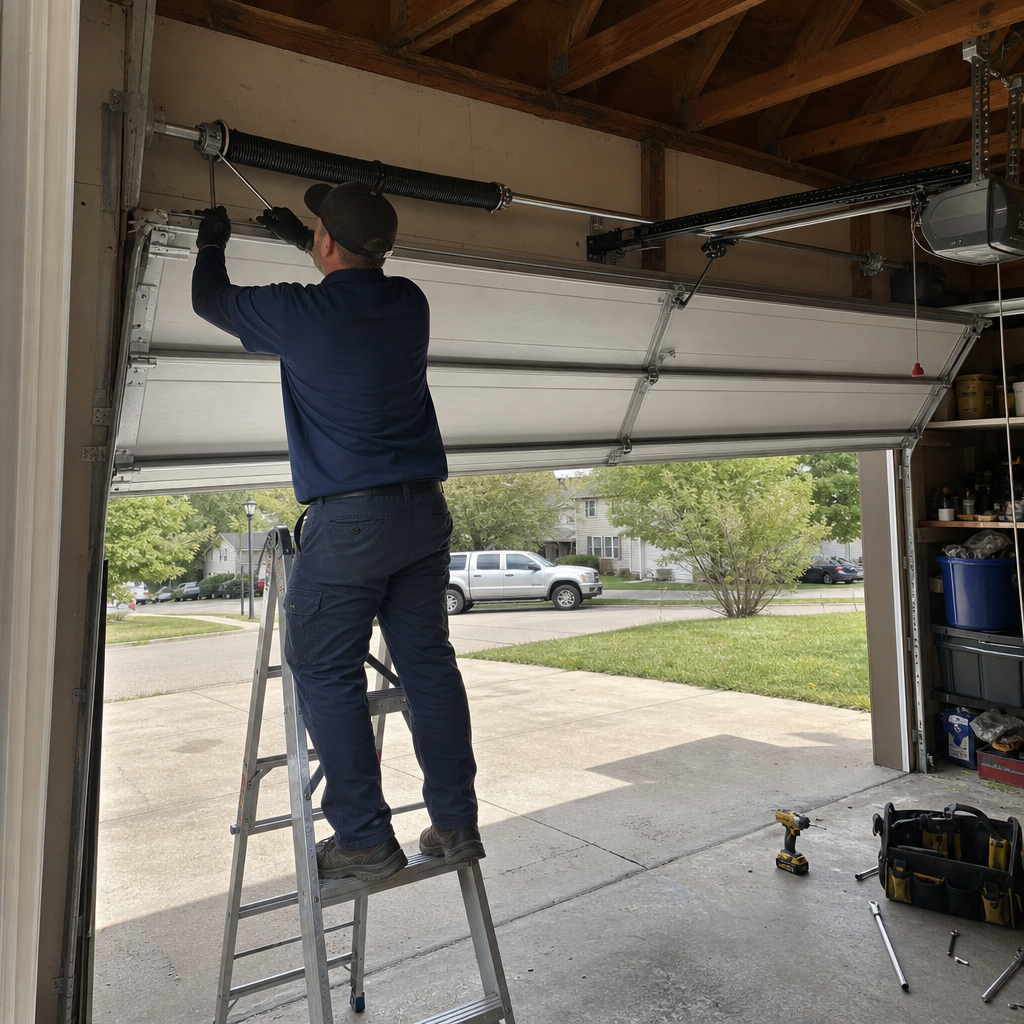
Last updated July 10, 2026
Garage Door Repair Maintenance Checklist for Akron Homeowners
Here’s a hard truth from eight years of knocking on doors across Akron: WD-40 is the single most common thing homeowners spray on their garage door springs and rollers — and it’s one of the fastest ways to destroy both. We’ve pulled into driveways in Firestone Park and Ellet where a $15 can of the wrong lubricant turned a five-year spring into a two-year failure. In Akron’s climate, with our freeze-thaw cycles and road salt that tracks into every garage from November through March, the generic maintenance advice you’ll find online doesn’t just miss the mark — it actively costs you money. This guide gives you a month-by-month checklist calibrated to what actually happens to garage doors in Summit County, the specific products that survive sub-zero mornings, and the warning signs that tell you a spring has 60 to 90 days left before it snaps.
Quick Answer
A proper garage door maintenance checklist for Akron homeowners includes monthly visual inspections, quarterly hardware tightening, bi-annual lubrication with silicone-based or lithium-grease products rated below 20°F, and seasonal weather seal checks before winter and after salt season. Torsion springs should be professionally inspected annually due to high-tension injury risk. The complete schedule below is built around Akron’s freeze-thaw cycles, road salt exposure, and temperature swings that accelerate wear faster than national manufacturer guidelines predict.
Table of Contents
- Why Akron’s Climate Destroys Garage Doors Faster Than National Averages
- Monthly Maintenance Tasks Every Akron Homeowner Should Do
- Seasonal Deep Maintenance: Spring and Fall Protocols
- The Right Lubricants for Sub-Zero Temperatures (and What Destroys Your Door)
- How to Check Spring Tension Safely — and When to Stop
- Weather Seals and Road Salt: Why Akron Doors Need Twice the Attention
- Garage Door Opener Maintenance for Cold-Weather Reliability
- Visual Warning Signs: Reading Your Door’s 60-90 Day Failure Clock
Why Akron’s Climate Destroys Garage Doors Faster Than National Averages
Akron sits at the edge of the snow belt, and that geographic reality changes everything about garage door maintenance. Our average January low hits 19°F, but the real damage comes from the swings — we’ll see 45°F afternoons collapse into single-digit nights, sometimes within hours. That thermal cycling causes steel components to expand and contract repeatedly, loosening hardware and stressing springs in ways a steady cold climate simply doesn’t.
The other factor national guides ignore: road salt. Akron’s proximity to I-77 and the Ohio Turnpike means every vehicle in your garage carries magnesium chloride and sodium chloride residue from November through April. That salt doesn’t stay on your floor — it aerosolizes, settles on tracks and springs, and accelerates corrosion even on “corrosion-resistant” hardware. We’ve replaced track systems in Wallhaven that looked five years older than their actual age solely from salt exposure.
Finally, our spring and fall weather creates condensation cycles. A 65°F March afternoon with melting snow outside means humid air hits cold steel inside your garage. That moisture breeds rust on cables and hinges precisely when most homeowners have shifted attention to lawn care, not garage maintenance.
What this means practically: The standard manufacturer recommendation of “annual professional inspection” assumes a moderate climate. In Akron, the inspection interval that prevents emergency calls is closer to every eight to ten months, with homeowner visual checks filling the gap.
Monthly Maintenance Tasks Every Akron Homeowner Should Do
These five checks take under ten minutes and catch 80% of the problems that strand Akron homeowners with a door that won’t open before work. Do them the first Saturday of each month — consistency matters more than perfection.
- Visual spring inspection. Stand inside your garage with the door closed. Look at the torsion spring above the door (or extension springs along the horizontal tracks). You’re checking for: gaps between coils, rust flakes, a slight unwinding at the ends, or any shiny “fresh metal” spots where the coating has worn through. In Akron, we see rust bloom accelerate dramatically after salt season — March and April monthly checks are critical. Never touch or attempt to adjust springs — the stored tension can cause serious injury.
- Track debris clearing. Run your hand along the inside of both vertical tracks (door open, opener disconnected). Remove accumulated grit, salt residue, and that fine black dust from roller wear. In winter, this dust mixed with moisture forms a paste that jams rollers. A dry cloth works — save solvents for the quarterly deep clean.
- Roller condition check. With the door closed, examine each roller. Nylon rollers should show no cracks or flat spots; steel rollers shouldn’t have visible rust pitting. Wiggle each roller in its bracket — excess play means the bearing is failing. In Goodyear Heights and North Hill, where many homes have original 1980s and 1990s doors, we see roller failure as the #1 cause of opener strain.
- Balance test. Disconnect the opener (pull the red release cord) and lift the door manually to waist height. It should stay put without drifting up or down. If it drifts, the spring tension is off — and in Akron’s climate, that usually means corrosion weakening the spring, not just normal stretch. Mark your calendar to call for professional adjustment.
- Reversal safety test. With the opener reconnected, place a 2×4 flat on the floor where the door meets the ground. Close the door with the remote — it must reverse within two seconds of contact. Test the photoelectric eyes by waving a broom handle through the beam during closing. Cold weather stiffens sensors and misaligns brackets; this test catches problems before they become safety failures.
Seasonal Deep Maintenance: Spring and Fall Protocols
Twice yearly — mid-April after salt season ends, and mid-October before the first hard freeze — set aside 45 minutes for comprehensive service. These are the maintenance sessions that extend door life by years in Akron’s conditions.
Spring Protocol (Post-Salt Season)
The priority is removing accumulated salt and assessing winter damage. Start with a complete hardware tightening: every bolt on hinges, roller brackets, track supports, and the opener mounting bracket. Use a socket set, not a screwdriver — the vibration of daily operation loosens fasteners more aggressively in climate zones with freeze-thaw cycling.
Clean all tracks with a degreaser (Simple Green Pro HD diluted 4:1 works well) followed by thorough drying. Apply lubricant per the section below — this is your main annual lubrication event. Inspect the bottom seal for hardening or cracking from cold; the rubber becomes brittle after a winter of contact with frozen concrete.
Check the exterior weather stripping on the door’s top and sides. Akron’s spring winds drive rain horizontally, and compromised stripping channels water into the garage, accelerating track rust.
Fall Protocol (Pre-Winter)
Focus shifts to cold-weather preparation. Re-test the balance test — spring tension often shifts over summer as humidity cycles affect the steel. Lubricate all moving parts with cold-rated product; standard lubricants that worked in July will gum up by January.
Inspect the bottom seal again, but now you’re looking for gaps that’ll admit cold air and meltwater. In West Akron and Highland Square, where many garages are detached and unheated, a failed seal can drop the interior temperature enough to freeze pipes in adjacent walls.
Verify opener force settings. Cold weather increases door weight (stiffer rollers, thicker grease residue) and requires slightly higher force — but too much force overrides safety systems. If your opener has adjustable force dials, note their current positions before any adjustment, and test the reversal system immediately after.
The Right Lubricants for Sub-Zero Temperatures (and What Destroys Your Door)
This is where most maintenance guides fail Akron homeowners. They say “lubricate moving parts” without specifying products — and the wrong choice turns lubrication into damage.
WD-40: The most common mistake we encounter. It’s a water displacer and light solvent, not a lubricant. On springs, it strips the factory protective coating and leaves a film that attracts dust. Within months, you’ve accelerated corrosion. On nylon rollers, it degrades the plastic. We’ve replaced rollers in Merriman Valley that failed in 18 months because of WD-40 application.
3-in-1 Oil and similar household oils: These gum below 30°F. By mid-January, they’ve turned to sticky tar that increases opener strain and collects abrasive grit.
What actually works in Akron:
- Silicone-based spray lubricants: Blaster Garage Door Lubricant or Liquid Wrench Silicone Spray maintain flow to -35°F. Apply to springs, hinges, and roller bearings (not nylon roller wheels themselves). Reapply every six months — the silicone film doesn’t attract dust and doesn’t degrade rubber or plastic components.
- White lithium grease: Lubriplate or CRC White Lithium Grease for steel-to-steel contact points — specifically the opener rail (screw or chain drive) and the curved portion of the track where horizontal meets vertical. Stays pliable to 0°F; for extreme cold, switch to lithium with PTFE additive.
- Graphite powder: For lock cylinders only. Never on tracks or springs — the black residue marks everything and provides no corrosion protection.
Application technique matters: For torsion springs, spray a light, even coat along the coil length while the door is closed. Operate the door twice to distribute. For hinges and roller bearings, one-second spray per point — excess drips onto your car and concrete. Wipe all surfaces after five minutes; visible wet lubricant after that point is excess that’ll collect debris.
On Amarr and Clopay doors with nylon rollers common in newer Akron construction, avoid any petroleum-based product on the roller wheels themselves. The nylon formulation in these brands reacts with hydrocarbons, causing swelling and binding. Silicone spray on the roller bearings only, never the wheel surface.
How to Check Spring Tension Safely — and When to Stop
Torsion springs store lethal energy. A standard 16×7 steel door spring holds roughly 10,000 foot-pounds of torque at rest. The safety boundary is clear: homeowners can observe and test, never adjust or repair.
What You Can Safely Do
The balance test described in the monthly checklist is your primary diagnostic. With the opener disconnected, the door should:
- Lift smoothly with one hand through the full travel
- Stay at any position between knee and shoulder height without drifting
- Lower controlled without slamming
If the door feels “heavy” on the way up, drifts down from waist height, or requires two hands to lift, the spring tension is incorrect. These symptoms in an Akron home during February or March often indicate internal spring corrosion from salt aerosol — the spring looks fine externally but has lost cross-section internally.
The Hard Stop — Call a Professional When You See:
- A visible gap between coils in a torsion spring (any gap means failure is imminent)
- A “stretched” appearance where the spring seems longer than memory suggests
- Any attempt to adjust using winding bars — this is never a homeowner task
- The door has dropped suddenly and now hangs crooked
In eight years, we’ve responded to three serious injuries in Akron from homeowners attempting spring work with YouTube tutorials. The economics are straightforward: professional spring replacement runs $180-$340 in the Akron market, while an ER visit starts at ten times that. Daniel shows up personally for these calls — the same person who answers the phone handles the repair, and the accountability is direct.
Weather Seals and Road Salt: Why Akron Doors Need Twice the Attention
National maintenance guides recommend annual weather seal inspection. For Akron, that’s insufficient — we recommend checking seals in October, January, and April.
The mechanism is specific to our region. Road salt (primarily sodium chloride and magnesium chloride) lowers the freezing point of water and increases its conductivity. When tracked into your garage on tires and boots, salt-laden meltwater pools at the door threshold. The bottom seal sits in this solution for weeks each winter, accelerating rubber degradation through a combination of chemical attack and freeze-thaw mechanical stress.
We’ve pulled seals from Kenmore and Fairlawn homes that looked superficially intact but had hardened to the consistency of plastic — zero compression, meaning they leaked air and water continuously. The homeowner didn’t notice because the failure was gradual, but their heating bills climbed and the track rust accelerated from the moisture intrusion.
Inspection Points:
- Bottom seal (U-shaped vinyl or rubber): Should compress easily between thumb and forefinger. If it feels stiff or cracks when flexed, replace. In Akron’s market, a standard 16-foot seal runs $25-$40 in parts; professional installation with proper track cleaning adds $75-$120.
- Threshold seal (mounted to floor): Often overlooked. Salt corrosion attacks the aluminum or PVC retainer. If the seal pulls away from the floor, water flows directly under the door.
- Side and top seals (bulb or fin type): Check for compression set — the seal no longer springs back to original shape. On Clopay doors with integrated vinyl seals common in 2000s Akron construction, the vinyl becomes brittle after 7-10 years and requires full retainer replacement.
After heavy salt application events (the week after every significant Akron snowfall), rinse the threshold area with plain water. No soap needed — you’re diluting salt concentration, not degreasing.
Garage Door Opener Maintenance for Cold-Weather Reliability
Garage door openers work harder in Akron winters than in Atlanta or Austin — not because the mechanism changes, but because the door itself becomes heavier. Stiffer grease, contracted cables, and ice accumulation all increase load. An opener that’s adequate in September may struggle dangerously by January.
Opener-Specific Tasks for Fall Preparation:
- Chain or belt tension: A properly tensioned chain has approximately 1/2 inch of sag at midpoint. Too loose causes jerky operation and premature sprocket wear; too tight overloads the motor. Belt drives (common on newer LiftMaster and Chamberlain units in Akron’s newer construction) shouldn’t have visible slack but shouldn’t hum under load.
- Rail lubrication: Screw drives need lithium grease on the entire threaded rod. Chain drives need light oil on the chain length — not the sprocket teeth, which will fling oil onto the door. Belt drives require no lubrication; any product application degrades the composite belt.
- Force limit verification: All modern openers have adjustable up-force and down-force settings. Test with the 2×4 reversal check, then note: if you need to increase down-force to get the door to close fully in cold weather, something else is wrong (track alignment, roller binding, or spring weakness). Increasing force to compensate for mechanical problems destroys safety margins.
- Battery backup test: Required on all openers sold after 2019, and critical in Akron where winter ice storms cause outages. Disconnect power and verify the opener completes at least one full cycle. Replace the battery every 3 years regardless of test results — cold reduces effective capacity.
For Genie openers with Intellicode systems common in 1990s and 2000s Akron homes, the logic board is vulnerable to voltage spikes from winter grid instability. A surge protector on the opener outlet costs $15; board replacement runs $180-$250 plus labor.
Visual Warning Signs: Reading Your Door’s 60-90 Day Failure Clock
After eight years and roughly 2,000 service calls, we’ve learned that catastrophic garage door failures announce themselves — if you know the visual language. These are the specific signs we look for during inspections, and what they mean for timing.
Torsion Springs: The Critical 90-Day Window
A torsion spring doesn’t fail suddenly without warning. The progression is predictable:
- Stage 1 — Surface rust with intact coating: Orange discoloration but no metal exposure. 12-18 months remaining in normal conditions, 6-10 months in high-salt Akron garages.
- Stage 2 — Coating failure with pitting: Visible bare metal, small pits where rust has penetrated. This is your 60-90 day warning. The pitting creates stress concentration; each cycle propagates micro-cracks.
- Stage 3 — Active flaking or “scaling”: Rust is shedding in visible flakes. 30 days or less. We’ve never seen a spring in this condition last through a full Akron winter.
- Stage 4 — Coil separation or visible gap: Immediate failure risk. Do not operate the door; the spring can unwind violently. Call for same-day service.
Cables: The Overlooked Failure Point
Lift cables fray from the bottom up — the drum end sees highest stress. Unwind the cable from the drum (with the door fully closed, spring tension on) and examine the last three feet. Any fraying beyond two broken strands means replacement. In Akron, salt corrosion attacks the cable at the bottom bracket first; look for swelling or stiffness in the lowest 18 inches.
Panels and Hardware:
Wayne Dalton and some Amarr doors use proprietary hinge designs that fail differently than standard hardware. The hinge pin wears oval, creating slop that manifests as door “wobble” during travel. By the time it’s visible, the adjacent panel is being stressed abnormally — replace the hinge immediately to avoid panel replacement.
Common Mistakes to Avoid
- Spraying WD-40 on springs and rollers. It strips protective coatings, attracts dust, and degrades nylon components. We’ve replaced prematurely failed parts in Akron homes where this was the only maintenance error.
- Ignoring the door after installing a new opener. A powerful new LiftMaster or Chamberlain can mask a failing spring for months — until the opener burns out or the spring snaps catastrophically. Always verify door balance before blaming opener problems.
- Using standard lithium grease without cold-temperature rating. The lithium grease that flows fine at 40°F becomes thick paste at 10°F. In Akron’s January mornings, this overloads motors and strips screw drive threads.
- Skipping the January seal check. National guides don’t account for mid-winter salt accumulation. That January inspection catches seal hardening before it becomes a spring flood event when snow melts.
- Attempting spring adjustment with improvised tools. Winding bars must be solid steel, exactly the diameter of the winding cone hole. We’ve seen pipe wrenches, screwdrivers, and even hammer handles used — all of which slip and cause injury. This is never a DIY task.
- Running the opener with a broken spring. The opener isn’t designed to lift full door weight. Continued operation strips plastic gears in chain drives and burns motor windings. If the door feels heavy or the opener strains, disconnect and call for service.
- Assuming all brands use the same maintenance protocol. Genie screw drives need different lubrication than Chamberlain chain drives. Clopay’s pinch-resistant panel designs have hinge points that collect debris differently than Wayne Dalton’s. Match maintenance to your specific equipment.
When to Call a Professional
Some maintenance is homeowner-appropriate; some crosses into genuine hazard. Call for professional service when you encounter: any spring-related issue (visual damage, balance problems, or noise from the spring area); cables that are frayed, off the drum, or showing corrosion swelling; doors that have come off the tracks or hang unevenly; opener problems that persist after verifying force settings and lubrication; or any situation where you’re unsure of the safety boundary.
Guardian Garage Door Repair Greater Akron offers free estimates in Akron — call (888) 763-4702. Daniel Lopez handles these calls personally, and if the assessment shows a problem you can safely address yourself, he’ll tell you directly. The door works, or we make it right.
Frequently Asked Questions
A professional tune-up in the Akron market typically runs $120-$180 for a standard residential door, including spring tension check, hardware tightening, lubrication with cold-rated products, safety system verification, and seal inspection. Spring replacement, when needed, adds $180-$340 depending on spring size and whether one or both springs require replacement. Call (888) 763-4702 for an exact quote — estimates are free.
Homeowners can safely handle monthly visual inspections, track cleaning, roller condition checks, balance tests, and weather seal assessments. Spring adjustment, cable replacement, and track realignment require specialized tools and training due to stored energy hazards — these should never be DIY projects. In eight years of fieldwork, we’ve seen serious injuries from homeowners attempting spring work with inadequate tools and knowledge.
Lubricate all moving parts in mid-October before hard freeze and mid-April after salt season — twice yearly minimum. If your garage is detached and unheated, or if you operate the door more than four cycles daily, add a light January touch-up on hinges and roller bearings only. Use silicone-based spray rated below 20°F; standard products gum in cold weather and increase opener strain.
Cold temperatures thicken residual lubricant, stiffen rubber seals, and contract metal components slightly out of optimal alignment. The noise is usually the opener working harder against increased resistance. Start with a balance test — if the door feels heavy manually, the spring may have weakened. If balance is good, clean and relubricate with cold-rated product. Persistent noise after these steps indicates professional adjustment is needed.
Standard torsion springs are rated for 10,000 cycles (roughly 7-10 years for typical use). In Akron’s climate, actual lifespan often runs 6-8 years due to salt aerosol corrosion and thermal cycling stress. Springs in garages with direct road salt exposure — homes near major Akron thoroughfares like Market Street or Canton Road — may fail sooner. Annual professional inspection catches degradation before catastrophic failure.
For doors under 15 years with isolated problems — failed spring, worn opener, damaged panel — repair is typically more economical. Replacement becomes cost-effective when: multiple panels are damaged, the door lacks modern safety features, or repair costs exceed 50% of replacement. In Akron’s market, a quality steel replacement door runs $1,200-$2,800 installed depending on size and insulation. Guardian Garage Door Repair Greater Akron provides transparent assessments — we’ll recommend repair when it makes sense, replacement when it doesn’t. Call (888) 763-4702 for a free evaluation.
The Bottom Line
Akron’s garage doors face freeze-thaw cycling, road salt corrosion, and thermal stress that national maintenance schedules don’t address. The homeowners who avoid emergency calls follow a calibrated schedule: monthly visual checks, seasonal deep maintenance with cold-rated lubricants, and professional inspection every 8-10 months rather than annually. The 60-90 day warning signs on springs are real and observable — catching them means replacing on your schedule, not during a January morning when you’re already late for work. WD-40 belongs nowhere near your door; silicone spray and white lithium grease rated for sub-zero use are the standards that survive Akron winters.
For homeowners who’d rather have a technician handle the full protocol, Garage Door Repair in Akron from Guardian includes complete inspection, adjustment, and honest assessment of what needs attention now versus what can wait. Garage Door Installation in Akron is available when repair no longer makes economic sense. And for Garage Door Opener in Akron issues, we work on your brand — whether that’s LiftMaster, Chamberlain, Genie, or others in our supported lineup.
Call (888) 763-4702 for a free estimate. Daniel shows up personally, diagnoses the door, and stands behind the work — 8 years, 250+ reviews, and the same accountability on every job.
Written by Daniel Lopez, Owner & Lead Technician at Guardian Garage Door Repair Greater Akron, serving Akron since 2018.