
Last updated July 10, 2026
Seasonal Garage Door Care for Akron: Year-Round Homeowner’s Guide
The highest rate of garage door spring failures in Northeast Ohio happens in the first two weeks of November — not because of cold, but because the rapid temperature drop causes metal to contract faster than the spring tension was set to handle. After eight years working on Akron garage doors, we’ve learned that treating seasonal care as a single annual checkup means you’re always reacting to damage rather than preventing it. This guide breaks down exactly what your garage door needs in each of Akron’s four distinct mechanical stress seasons — spring, summer, fall, and winter — so you stop emergencies before they strand your car in the driveway.
Quick Answer
Seasonal garage door care in Akron means adjusting your maintenance routine four times per year: checking balance and seals after spring freeze-thaw ground shifts, monitoring wood panel expansion during humid summers, testing spring tension before November’s contraction failures, and switching to cold-rated lubricant before temperatures drop below 20°F. A simple 30-second weekly balance test catches 80% of developing problems before they become emergency calls.
Table of Contents
- Spring: When Akron’s Freeze-Thaw Cycle Attacks Your Door’s Foundation
- Summer: Humidity, Wood Swell, and Track Binding
- Fall: The Pre-Winter Tension Check That Prevents November Failures
- Winter: Lubricant Failure and Cold-Weather Operation
- The 30-Second Weekly Test That Saves You Hundreds
- Common Mistakes to Avoid
- When to Call a Professional
- Frequently Asked Questions
Spring: When Akron’s Freeze-Thaw Cycle Attacks Your Door’s Foundation
Akron’s spring weather is brutal on garage door geometry. Between March and May, we typically see 40 to 60 freeze-thaw cycles — nights below freezing, afternoons above 50°F. That repeated expansion and contraction moves your garage slab, shifts your door frame, and changes how your door meets the ground.
Here’s what happens mechanically: when water in the soil freezes, it expands and lifts your concrete slab. When it thaws, the slab settles — but rarely to exactly the same position. After eight years of garage door repair in Akron, we’ve seen doors that sealed perfectly in October develop quarter-inch gaps by April. That gap lets rainwater run straight into your garage, and in neighborhoods like Firestone Park and Goodyear Heights where clay-heavy soil holds more moisture, the movement is more pronounced.
Your spring checklist:
- Check bottom seal contact across the full width. Close the door and look for daylight underneath. Run a flashlight on the outside while someone stands inside — any beam coming through means water, mice, and cold air are getting in.
- Test door balance with the opener disconnected. Pull the red release handle and lift the door manually to waist height. It should stay put. If it drifts up or down, the spring tension no longer matches the door’s actual weight — and after slab movement, that mismatch gets worse.
- Inspect weatherstripping on the sides and top. Akron’s spring winds carry grit that embeds in rubber seals and accelerates wear. Look for cracking, hardening, or sections that no longer compress against the door.
- Check track mounting brackets. Slab shift puts lateral stress on vertical tracks. Make sure brackets are tight to the wall and tracks remain plumb — not leaning in or out at the bottom.
In West Akron and Highland Square, where many garages date to the 1920s-1950s, we see more foundation movement than in newer subdivisions like Wallhaven. Older concrete was poured without modern expansion joints and reacts more dramatically to soil moisture changes. If your door worked fine last fall and suddenly rubs or sticks this spring, the slab moved — not the door.
One more spring-specific note: this is when we get calls about garage door opener strain. When the door’s physical alignment changes, the opener works harder. A LiftMaster or Craftsman unit that previously lifted smoothly starts tripping safety reverses or making grinding sounds. The opener isn’t failing — the door geometry is fighting it. Fix the door first, or you’ll burn out a perfectly good motor.
Summer: Humidity, Wood Swell, and Track Binding
Akron’s July humidity regularly hits 70-80%, and if you have a wood garage door — common in Merriman Valley, Fairlawn Heights, and throughout the 44313 zip code — that moisture goes straight into the panels. A standard wood door panel can expand 1/8 to 3/16 inch across its width in humid conditions. That doesn’t sound like much until it’s rubbing against your track or jamming at the top of the opening.
We’ve responded to summer emergency calls where the homeowner swears the opener failed, but the real problem is a swollen middle panel catching the vertical track. The opener’s safety reverse activates, the door goes back up, and the homeowner thinks they need a new motor. What they need is clearance adjustment — and better summer maintenance.
Summer-specific inspection points:
- Panel-to-track clearance: With the door closed, you should see consistent gap between wood panels and steel track on both sides. If the gap disappears at any point, humidity expansion is the likely cause. Don’t force the door — you’ll split the panel or bend the track.
- Paint and seal condition: Wood doors in Akron need repainting or resealing every 3-5 years. Once the factory finish cracks, summer humidity penetrates faster. Check the top edge of the top panel especially — it’s the most sun-exposed and first to fail.
- Steel door condensation: Non-insulated steel doors sweat in humid garages. That moisture rusts bottom fixtures and corrodes cables. If your steel door drips in summer, consider adding insulation or improving garage ventilation — or expect faster hardware degradation.
- Opener thermal overload: Garage temperatures in Akron can reach 95-105°F in unventilated spaces. Older Genie or Raynor opener motors run hotter and may trip thermal protectors. If your opener works fine mornings but quits afternoons, heat is the culprit.
Summer is also when we see the most misdiagnosed “opener failures” in Akron. Before you assume the motor is dead, disconnect the opener and test the door manually. If it’s heavy or binds, the problem is mechanical — and no opener replacement will fix it. We’ve saved homeowners hundreds by catching this during summer service calls in Ellet and Kenmore.
Fall: The Pre-Winter Tension Check That Prevents November Failures
October is the most important garage door maintenance month in Northeast Ohio. Not September — by then, temperatures are still moderating. Not November — by then, the failures have already started. The two weeks before Halloween are when we schedule our heaviest preventive work, because what you do in mid-October determines whether your door survives the thermal shock of early November.
Here’s the physics: your torsion springs were tensioned at a specific temperature, usually 60-75°F during installation or last adjustment. Every 10°F drop reduces spring wire diameter microscopically through thermal contraction. When Akron drops from 65°F to 35°F in a single week — common in late October — the spring contracts, increasing its effective tension. But if the spring was already near its cycle limit (typically 10,000 cycles for standard springs), that sudden tension spike fractures the wire.
We’ve tracked our Akron call history: spring replacement volume jumps 340% in the first two weeks of November versus the monthly average. The doors don’t fail in January’s deep cold. They fail in the transition.
Fall tension check protocol:
- Count your cycles. Average household use is 3-4 cycles per day (morning out, evening in). At 4 cycles, that’s 1,460 per year. A standard 10,000-cycle spring lasts roughly 6-7 years. If you’re approaching that age, fall is replacement season — not after it breaks.
- Listen for the “tick” of winding cone slip. When springs weaken, the winding cone can micro-slip on the shaft during operation. You’ll hear a faint metallic click as the door starts moving. That’s the spring telling you it’s losing grip.
- Check door speed. A properly tensioned door moves smoothly and consistently. If it starts fast then slows, or hesitates at certain points, spring torque is uneven. Cold weather will exaggerate this into a full stop.
- Inspect spring coils for gaps. Torsion springs should have coils touching or nearly touching when the door is closed. Visible gaps between coils mean the spring has stretched and lost tension — it’s working your opener harder and will fail under cold contraction stress.
We replace more broken springs in North Hill and Middlebury in November than any other neighborhood — not because those areas are colder, but because the housing stock skews older with original springs that have cycled past their design life. If your Akron home was built before 2010 and still has original springs, October is your decision month. Replace them preventively, or replace them in an emergency when your car is trapped inside.
Safety note: Torsion springs store massive mechanical energy. A standard 7-foot door spring holds roughly 100-150 foot-pounds of torque. Adjustment or replacement requires winding bars inserted into a loaded spring under tension. We’ve seen serious hand and face injuries from homeowners using screwdrivers or makeshift tools. This is not a DIY procedure — the risk of permanent injury far exceeds any savings.
Winter: Lubricant Failure and Cold-Weather Operation
Standard garage door lubricant — the white lithium grease most homeowners grab at the hardware store — stops flowing properly around 20°F. At 10°F, it’s essentially a thick paste. At 0°F, it’s a solid film that provides no lubrication and actually increases resistance. Akron sees 15-20 nights below 10°F most winters, and January 2022 brought three consecutive days that never rose above 5°F.
When lubricant fails, metal rides on metal. H rollers grind in steel tracks. Chain drives on older Craftsman openers chatter and stretch. Torsion springs squeal as coils bind against each other. The door works harder, the opener strains, and components fail faster.
Cold-weather lubrication rules for Akron:
- Switch to cold-rated synthetic lubricant before Thanksgiving. Look for products rated to -40°F or lower. We use a synthetic spray with PTFE that maintains film strength at extreme cold. Apply to rollers, hinges, bearing plates, and spring coils.
- Never use WD-40 as a lubricant. It’s a solvent and water displacer, not a lubricant. It evaporates and leaves residue that attracts grit. We remove more gummed-up hardware caused by WD-40 than any other homeowner mistake.
- Grease the opener rail sparingly. Chain and screw drives need light lubrication on the rail, but belt drives (common on newer LiftMaster models) should never be greased — the belt will slip and throw off travel limits.
- Check weatherstripping flexibility. Cold hardens rubber. If your bottom seal is cracking or no longer flexes when you press it, replace it before January. A rigid seal won’t conform to slab irregularities and lets wind-driven snow infiltrate.
Winter in Akron brings a specific hazard we see repeatedly: ice formation between door sections. When snow melts on the door during a sunny 35°F afternoon and refreezes overnight at 15°F, the sections can lock together. The opener tries to lift, encounters resistance, and either trips the safety reverse or damages the top section. If your door is frozen shut, don’t force the opener. Use a hair dryer or heat gun on low to melt the ice between sections, or call for Guardian Garage Door Repair Greater Akron home service if the ice has damaged hardware.
Garage heater users in neighborhoods like Bath and Copley — where attached garages are common — face a different winter issue: thermal cycling from heater use creates condensation on cold steel components when the heater cycles off. That moisture rusts springs and cables faster than consistent cold. If you heat your garage, maintain steady temperature rather than wide swings, or accept that you’ll replace hardware more frequently.
The 30-Second Weekly Test That Saves You Hundreds
There’s one test we teach every Akron homeowner, and it catches the vast majority of developing problems before they become emergency calls. It takes 30 seconds, requires no tools, and reveals spring tension, balance, track alignment, and opener strain simultaneously.
The manual balance test:
- Close the door fully.
- Pull the red emergency release handle to disconnect the opener.
- Lift the door manually to about waist height (3-4 feet off the ground).
- Let go.
What the door tells you:
- Stays put: Spring tension matches door weight. This is correct.
- Drifts down: Springs are weakening or were improperly tensioned. The opener is working harder than designed, and failure is coming.
- Drifts up: Springs are over-tensioned. Rare but dangerous — the door can slam unexpectedly.
- Feels heavy or binds: Track alignment issue, roller wear, or panel damage. Something mechanical is fighting smooth operation.
Perform this test every Saturday morning, or the first time you use the door each week. When the behavior changes — a door that used to stay put starts drifting — you have early warning. In our experience across 250+ Akron-area jobs, homeowners who run this weekly test call us for scheduled maintenance instead of midnight emergencies. The difference is typically $150-250 versus $400-600, plus your Saturday back.
If you notice drift, binding, or weight change, don’t adjust springs yourself. Note the behavior and call for evaluation. We can often correct minor tension issues in a single visit before they escalate to full spring replacement or opener damage.
Common Mistakes to Avoid
- Waiting for a loud noise before acting. By the time a torsion spring makes the characteristic “gunshot” bang, it’s already failed and often damaged the door or opener. The weekly balance test catches weakening springs silently.
- Using the wrong lubricant in winter. That white lithium grease in your garage cabinet? It’s fine for April through October. From November through March in Akron, it actively harms performance. Switch to synthetic cold-rated spray before the first hard freeze.
- Ignoring slab movement after wet springs. Firestone Park and Goodyear Heights homeowners especially — if your bottom seal gap appeared after a rainy May, it won’t fix itself by fall. Water intrusion accelerates concrete spalling and rusts bottom fixtures.
- Replacing the opener when the door is the problem. We see this monthly: homeowner buys a new LiftMaster because the old one “can’t handle the door.” The new one strains too, because the door is out of balance or binding. Always test manual operation first.
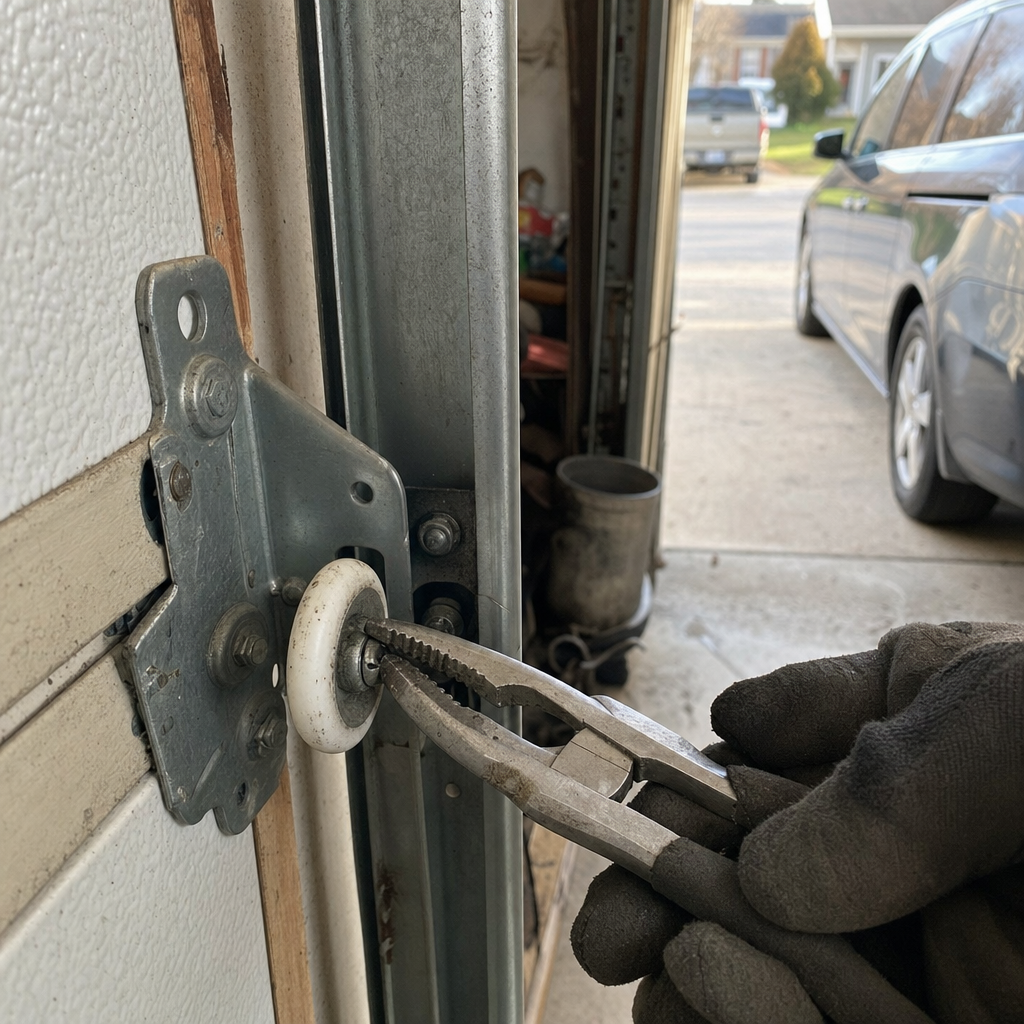
- DIY spring adjustment with improper tools. Using pliers, screwdrivers, or socket extensions as winding bars has caused serious injuries in Akron hospitals. The proper tools are solid steel winding bars inserted fully into the cogs. Even then, one slip can be catastrophic.
- Neglecting the emergency release. That red handle should move freely and disconnect the opener instantly. If it’s stiff or corroded — common in humid Akron summers — you can’t open the door manually during a power outage or opener failure.
- Assuming all brands are the same. Wayne Dalton’s TorqueMaster spring system requires entirely different service procedures than standard torsion setups. Raynor’s pinch-resistant hinges have specific lubrication points. Working on your brand correctly matters — we service eight major lines specifically because the details differ.
When to Call a Professional
Some garage door issues are maintenance items you can handle. Others require trained assessment — both for safety and because misdiagnosis wastes money. Call for professional evaluation when you notice: broken or frayed cables (these work alongside springs and are equally dangerous), doors that won’t stay open manually, opener straining or thermal shutdown, visible track damage or separation from wall brackets, or any spring-related symptom including drift, noise, or visible coil gaps.
Daniel shows up personally for every garage door installation in Akron and repair call — the same person who answers your questions is the one with tools in hand. Guardian Garage Door Repair Greater Akron offers free estimates in Akron. If you’re unsure whether a symptom needs immediate attention or can wait, call (888) 763-4702 and we’ll talk through what you’re seeing. Emergency service is available when a broken door can’t wait until Monday — because a garage that won’t close in November isn’t just an inconvenience.
Frequently Asked Questions
A professional tune-up in the Akron market typically runs $89-$150, depending on door size and whether spring tension adjustment is needed. That covers balance testing, hardware inspection, lubrication with season-appropriate products, and safety sensor verification. Call (888) 763-4702 for an exact quote — estimates are free, and we can often schedule same-week.
Homeowners can safely handle visual inspection, weatherstripping checks, and the weekly balance test we describe above. Spring tension adjustment, cable replacement, and track realignment require specialized tools and training — the injury risk from torsion springs specifically isn’t worth the savings. In eight years, we’ve treated too many preventable injuries from DIY spring work.
The rapid temperature drop in late October and early November causes faster metal contraction than the gradual cooling of midwinter. Springs tensioned in summer heat experience sudden stress spikes. By January, temperatures have stabilized and the metal has adjusted. It’s the transition, not the absolute cold, that breaks components.
Standard 10,000-cycle springs last 6-7 years at average use. Akron’s freeze-thaw cycles and humidity extremes accelerate wear slightly — we typically see replacement need at 5-7 years rather than the theoretical 8-10. If your springs are original to a pre-2018 home, have them assessed this fall before failure season.
Humidity affects both. Wood panels swell and bind. Steel doors sweat in uninsulated garages, rusting bottom hardware and corroding cables. We’ve replaced more cables in humid Akron summers than dry winters — the moisture does more damage than cold alone. Insulated steel doors or improved garage ventilation reduces both problems.
We work on your brand — specifically LiftMaster, Chamberlain, Genie, Clopay, Amarr, Wayne Dalton, Craftsman, and Raynor equipment. These eight lines cover the vast majority of residential garage doors in Akron, from vintage Craftsman chain drives to current LiftMaster belt-drive smart openers. If you’re unsure of your brand, the model plate is usually on the opener motor housing or door interior.
The Bottom Line
Akron’s four seasons create four distinct stress patterns for garage doors: foundation movement in spring, humidity swelling in summer, thermal contraction in fall, and lubricant failure in winter. Treating maintenance as a once-a-year event leaves you vulnerable to three-quarters of these failure modes. The homeowners who avoid emergency calls run simple seasonal checks — especially the 30-second weekly balance test — and address symptoms when they first appear, not when the door stops moving. After eight years and 250+ verified reviews, we’ve learned that prevention costs a fraction of emergency repair, and the best tool is awareness of what your door is telling you.
Need help with seasonal maintenance or worried about a symptom you’ve noticed? Garage Door Repair in Akron is our core service — Daniel shows up personally, diagnoses your specific door and brand, and explains exactly what we’re seeing before any work begins. Call Guardian Garage Door Repair Greater Akron at (888) 763-4702 for a free estimate. Emergency service available when waiting isn’t an option.
Written by Daniel Lopez, Owner & Lead Technician at Guardian Garage Door Repair Greater Akron, serving Akron since 2018.